
The Borrowed Future, The Infrastructure of Inequality & The Photo-Op Summit

Kareem’s Daily Quote: Hunter S. Thompson’s weird take on weird.
Stealing from the Grandkids: The truth about our National Checkbook.
Video Break: Golden Tempo!
Gas Prices: No, we’re not all carrying the same burden.
The China/U.S. Summit: What has the two-month delay given us?
What I’m Watching: Greyhound
Jukebox Playlist: Blueberry Hill
Kareem’s Daily Quote
“When the going gets weird, the weird turn pro.” Hunter S. Thompson
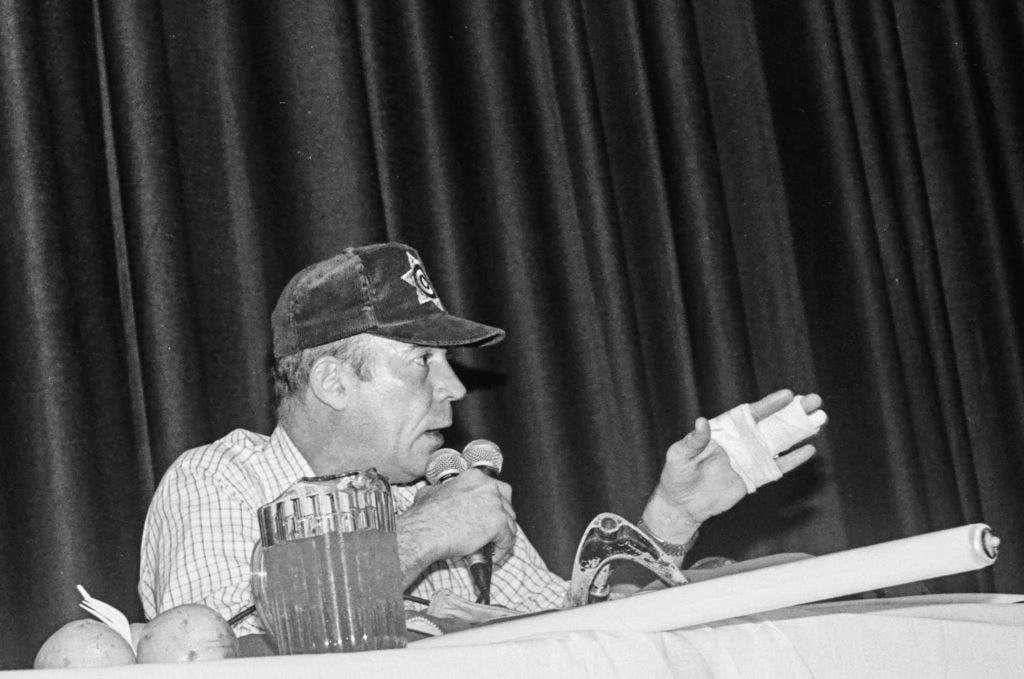
Hunter S. Thompson, the patron saint of high-velocity journalism, wrote the above in his campaign diary, Fear and Loathing: On the Campaign Trail '72. It’s the kind of sentence that works well on a T-shirt, but it’s more complex than it seems. It isn’t just about some people being eccentric; it’s about what happens when the “normal” world stops making sense and the only people left standing are the ones who were already comfortable on the fringes.
To understand what Thompson meant, you have to look at “weird” as a specialized skill set. In a stable, predictable world, “pro” behavior is about following the manual, staying within the lines, and trusting that the scoreboard is accurate. But what if we don’t live in that world anymore? What if we live in an era of 100% debt-to-GDP, shifting global loyalties, and systems that feel like they’re held together by Scotch tape and spit? What happens, in other words, if the manual catches fire? What happens is that the people who spent their lives reading it are the first to get burned.
Thompson’s weird-folks-turned-pros are the outsiders, the obsessives, the hustlers, the radicals and eccentrics and psychologically unconventional. They are the ones who don’t wait for a permission slip to act. In basketball, we’d call this “court vision”: the ability to see a play developing before the defense even realizes the ball has been snapped. When the game gets frantic and the crowd is screaming, the elite players don’t speed up; they slow down. They turn the weirdness into an advantage.
Thompson’s “turn professional” means that people move from the spin of the hurricane to the eye. They stop dabbling and become highly effective operators. So is that what Thompson is suggesting we do? Try to find that eye of the hurricane? Sit inside it as we would a storm cellar and bide our time until the weather changes?
Not remotely.
Thompson is not necessarily admiring them. He’s simply pointing out that, in bizarre times, unconventional people may understand reality better than respectable mainstream figures. But he also underscores that chaos creates opportunities for dangerous opportunists, manipulators, and fanatics who seem to thrive when institutions break down. That ambiguity—are these people good or bad?—is very Thompson-like. He distrusted “normal” authority figures, but he also knew that the counterculture and the fringe could become predatory, theatrical, or power-hungry.
When things in Washington and Wall Street get weird, when the debt spikes or the energy markets fracture, the traditional leaders often double down on the same old stories. They try to apply 1950s logic to a 2026 reality. This creates a power vacuum for the “weird,” those who were already adapted to a world that doesn’t follow the rules. During times of stability, institutions run things. During times of instability, those already adapted to instability suddenly gain influence.
What we’ve been seeing in the past few months is the emergence of “professional weirdos” seeking power. Are they creative truth-tellers? Or merely terrifying opportunists? Both possibilities are wide open. As always, it’s up to “we the people” to take a breath, discern the difference, and act accordingly.
